Why the Midgard Serpent Bites Its Tail: The Hidden History of the Ouroboros
Jörmungandr, the Midgard Serpent
The myth of Jörmungandr, the Midgard Serpent, serves as a cornerstone of Old Norse cosmology, embodying the tension between preservation and destruction. While often viewed simply as a monstrous antagonist to Thor, a scholarly examination reveals the serpent as a manifestation of Norse cyclicality—a concept that mirrors the Mediterranean and Near Eastern Ouroboros.
I. Jörmungandr: The Boundary and the Bond
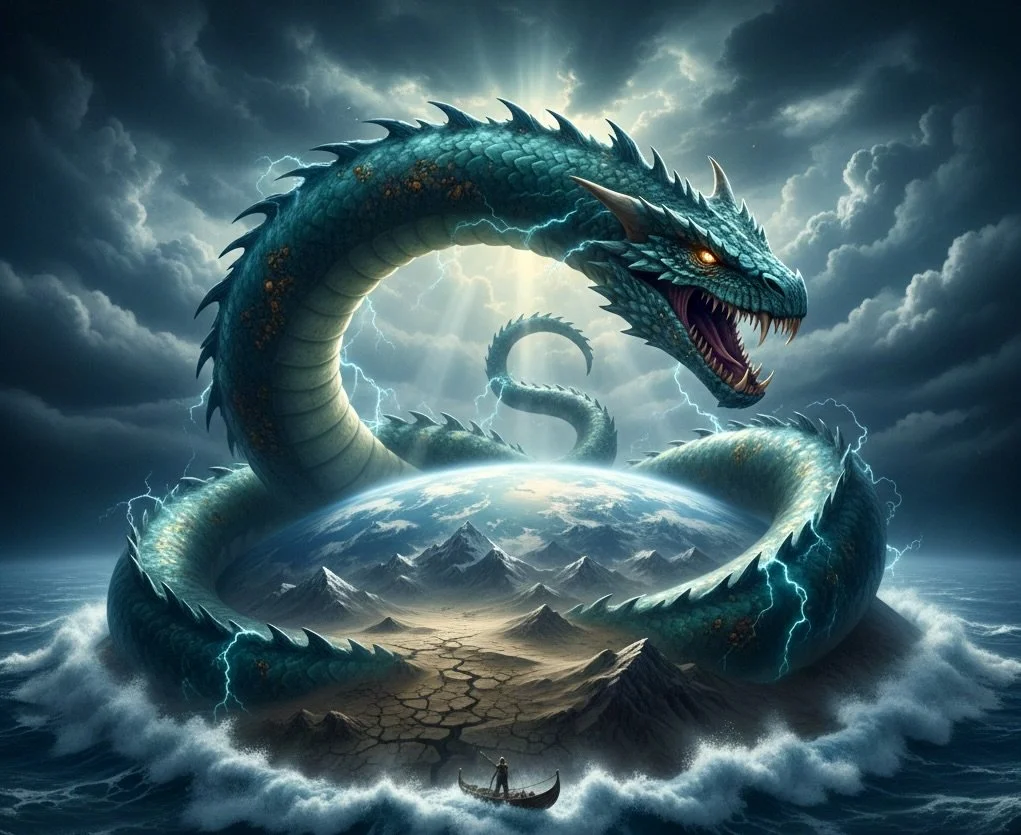
In the Prose Edda, Snorri Sturluson describes the serpent’s origin as a child of Loki and Angrboða. Fearing the creature's potential, Odin cast it into the deep ocean surrounding Midgard. Sturluson notes:
"He threw the serpent into the deep sea which surrounds all lands, and there the serpent grew so that he lies in the middle of the ocean surrounding all lands and bites his own tail" (Sturluson 1987, 27).
This physical configuration is not merely a biological quirk; it is a cosmological necessity. By "biting its own tail," Jörmungandr defines the limits of the known world. It is the útagarðr (the chaotic outer world) held in check by its own circularity.
II. Cyclicality and the Mechanical Doom
Unlike the modern linear view of time, Norse mythology operates on a cyclical, yet entropic model. The serpent represents a "stasis of tension." As long as the serpent holds its tail, the world remains intact. However, the myth of Ragnarök dictates that this circle must break.
The Struggle: In the Hymiskviða, Thor’s attempt to pull the serpent from the sea during a fishing trip foreshadows the end of the cycle.
The Release: The Völuspá describes the serpent’s arrival at the final battle: "The belt of the world [Jörmungandr] writhes in giant-rage... the serpent lashes the waves" (Larrington 2014, 8).
The death of Jörmungandr and Thor is a simultaneous exchange of energy. As Carolyne Larrington suggests, the serpent’s release of its tail is the literal "unraveling" of the cosmic order, making way for a new earth to rise from the sea, thus completing the cycle (Larrington 2014).
III. Comparative Mythology: The Ouroboros Connection
The Midgard Serpent is the Germanic iteration of the Ouroboros, a symbol found in Egyptian, Gnostic, and Alchemical traditions. While the Ouroboros often represents the "All is One" (Hen to Pan), the Norse interpretation adds a layer of active containment.

Scholar Mircea Eliade argues that such symbols represent "the myth of the eternal return," where the serpent swallowing its tail signifies time consuming itself to be reborn (Eliade 1954). In the Norse context, the serpent is the "lock" on the world; its release is the "key" to the next age.
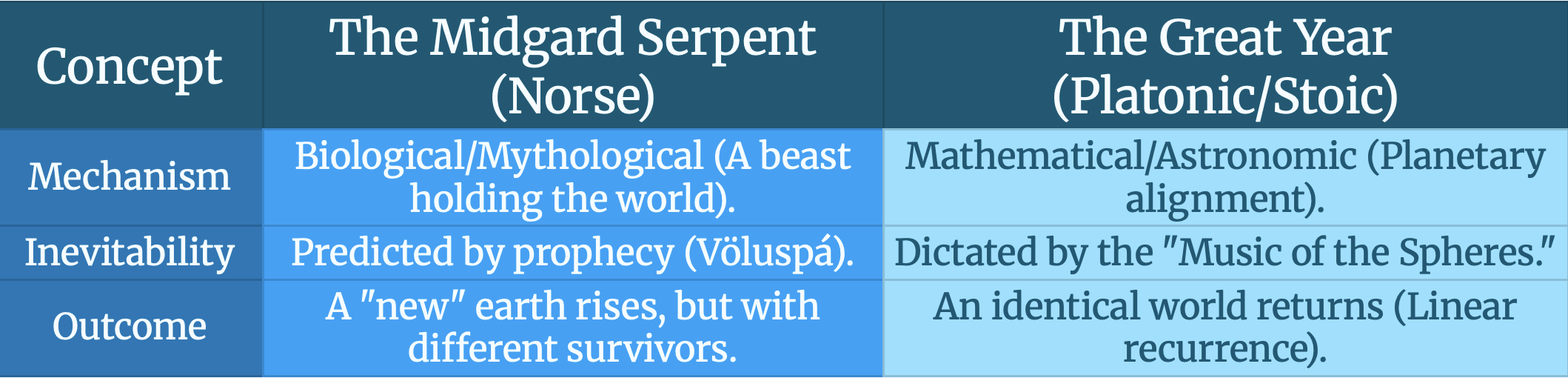
To understand the intersection of Norse cyclicality and Greek philosophy, we must examine the transition from a "doom-based" cycle to a "mathematical" cycle. While the Norse Ragnarök emphasizes a catastrophic breaking of the world-circle (the Serpent), the Greek Great Year (Magnus Annus) treats time as a perfect, repeatable geometric revolution.
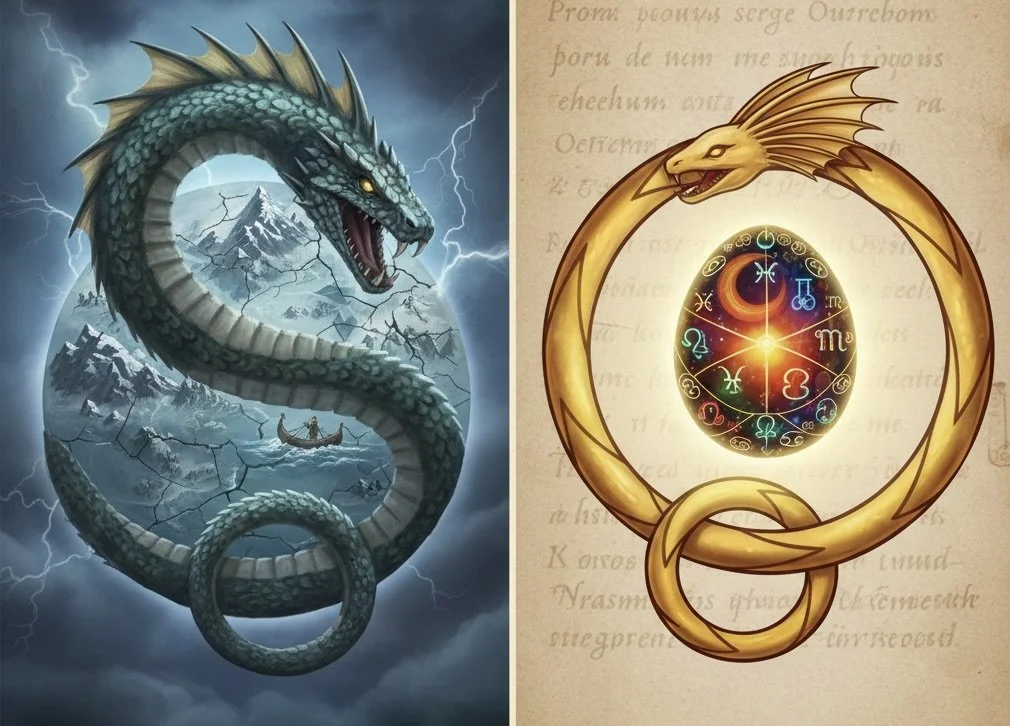
Jörmungandr vs. The Ouroboros: Cyclaclity Visualized
Jörmungandr the Midgard Serpent (left) and The Ouroboros (right).
IV. The Stoic Ekpyrosis vs. Ragnarök
The most direct parallel to the Midgard Serpent’s role in the end of the world is the Stoic concept of Ekpyrosis—the periodic destruction of the universe by fire.
The Norse Model: Destruction is a moral and physical "debt" paid by the gods. When Jörmungandr releases his tail, the venom he spews represents the corruption of the previous age.
The Greek Model: According to Heraclitus and later Stoics like Chrysippus, the universe is refined by fire. It is not a "tragedy" but a purification.
As scholar Mircea Eliade notes, the Greek cycle is often viewed through the lens of the Ouroboros as a symbol of "Eternal Return," where the universe returns to its identical starting state:
"The Stoics... asserted that the universe is periodic and that it is destroyed and reconstituted at the end of a 'Great Year'" (Eliade 1954, 89).
V. The Great Year (Magnus Annus)
The "Great Year" is a calculation of the time it takes for the Sun, Moon, and five planets to return to the same relative positions. This creates a "perfect circle" in time, much like the physical circle Jörmungandr creates in space.
VI. The Serpent as the "Girdle" of Time
In Greek Orphic mysteries, the figure of Chronos (Time) is often depicted as a serpent entwining the world egg. This mirrors Jörmungandr’s physical position. However, while Jörmungandr is a "shackle" that eventually breaks, the Orphic serpent is the "generator" of the cycle.
The profound link lies in the Ouroboros as a bridge between these two cultures. In Norse myth, the serpent biting its tail is a temporary hold on chaos. In Greek philosophy, the Ouroboros (specifically in Alchemical and Neoplatonic texts) represents the Autovoros—the self-devouring nature of time that ensures nothing is ever truly lost, only recycled.
Works Cited
Eliade, Mircea. The Myth of the Eternal Return: Or, Cosmos and History. Translated by Willard R. Trask. Princeton: Princeton University Press, 1954.
Larrington, Carolyne, trans. The Poetic Edda. Revised edition. Oxford: Oxford World’s Classics, 2014.
Lindow, John. Norse Mythology: A Guide to the Gods, Heroes, Rituals, and Beliefs. Oxford: Oxford University Press, 2001.
Long, A. A. Hellenistic Philosophy: Stoics, Epicureans, Sceptics. Los Angeles: University of California Press, 1986.
Plato. Timaeus and Critias. Translated by Desmond Lee. London: Penguin Classics, 2008.
Simek, Rudolf. Dictionary of Northern Mythology. Translated by Angela Hall. Cambridge: D.S. Brewer, 1993.
Sturluson, Snorri. Edda. Translated by Anthony Faulkes. London: Everyman, 1987.
Turville-Petre, E.O.G. Myth and Religion of the North: The Religion of Ancient Scandinavia. London: Weidenfeld and Nicolson, 1964.
