
We stand at the precipice of a profound transmutation, where the dormant stones of Saint Joseph’s Church in Albany, New York, are awakened to serve as the physical vessel for Philos Mystica. In this great work, we do not merely execute a business plan; we architect a new paradigm of belonging that bridges the divide between commercial viability and aesthetic transcendence. To transform the institutional resonance of Philos Mystica is to engage in the Nigredo of rebranding—the necessary dissolution of the old form to reveal the Diamond of Necessity within the Sanctuary of Blue.
The following analysis integrates the four critical lenses of our methodology: Business Strategy, Financial Modeling, Architectural Design, and Historical Restoration. Through these perspectives, we shall navigate the $20,000,000 capitalization required for this landmark cultural institution, the enduring sanctuary of a Neo-Gothic cathedral.
Discover our Plan
Lens I: The Business of Becoming, Market Fit and Narrative Sovereignty
The market fit for Philos Mystica rests upon the convergence of four potent macro-trends: the disillusionment with traditional higher education, the $5.6 trillion global wellness economy, the resurgence of narrative-driven Sacred Commerce, and the systemic loneliness epidemic of the post-pandemic digital era.
By reclaiming Saint Joseph’s Church, we solve the "Crisis of the Threshold," where marginalized seekers—particularly the neurodivergent and LGBTQIA+ communities—are currently forced to choose between clinical environments that pathologize their experience and retail spaces that commodify their identities.
The Seeker Economy and Demographic Transmutations
The identification of our primary demographic, the "Luminous Strange," requires a sophisticated understanding of the Seeker Economy. This is not a market of mere consumers, but of "Citizens" seeking restorative luxury—defined not by opulence, but by sensory safety and narrative complexity.1 The residency artist population in Albany grew by 50% between 2011 and 2021, signaling a robust local base for our "Legacy Ally" segment, while the Hudson Valley migration creates a corridor of high-net-worth seekers from New York City searching for destination-based cultural experiences.
The "Silver Tsunami" represents a critical future market; by 2030, nearly seven million Americans over 50 will identify as LGBTQIA+. This demographic faces a specific crisis in traditional elder care, with 85% fearing discrimination in senior living facilities. Philos Mystica’s Firinne Haven is uniquely positioned to offer "Inclusive Longevity," expanding the Wing of Salt to include permanent supportive housing where identity is celebrated as a "Sacred Story" rather than a clinical liability.
The Philosophy of Sacred Commerce
Traditional retail is in a state of terminal decline, yet "Narrative Retail" is flourishing. The Nave Boutique does not sell inventory; it sells "artifacts of becoming." The psychological moat here is "Safety as a Product." For the neurodivergent community, sensory-friendly environments—characterized by intentional acoustics, low-flicker lighting, and predictable social scripts—are a luxury good that remains largely inaccessible in conventional commercial settings. By partnering with LGBTQIA+ artisans in a 70/30 consignment split, we support a living artisan community, transforming consumption into a form of cultural patronage.
Lens II: The Financial Athanor, Modeling, ROI, and the Capital Stack
The projected revenue growth from $2.7 million in 2026 to $121.4 million in 2030 represents an aggressive scaling that relies heavily on the Digital Scriptorium and Philos Mystica University as high-margin, scalable engines. To maintain this velocity, the financial strategy must utilize a sophisticated Stack that minimizes debt service during the vulnerable Nigredo phase of restoration.
The $20M Capital Stack and Grant Synergy
Securing the initial $5,000,000 for Phase 1 is the most critical hurdle. We recommend Grant Stacking to lower the entry barrier. Saint Joseph’s is eligible for several specialized funding streams that function as trapped gold within the structure.
Funding Lever, Mechanism and Economic Impact for Philos Mystica
Historic Tax Credits (HTC): 20% Federal + 20% NY State - $8M equity injection over restoration life.
Opportunity Zone 2.0: Permanent tax exclusion - Attracts $3.5M in impact investor seed capital.
ESSHI Subsidy: Supportive Housing - $31,000 annual per-unit subsidy for Firinne Haven.
NY Landmarks Grant: Exterior Restoration - $50,000 matching grant for facade stabilization.
DRI / Restore NY: Neighborhood Anchor and positioning as a catalytic investment for Arbor Hill.
The financial resilience of Philos Mystica is predicated on a Cross-Subsidization model. High-margin revenue streams, such as the $5,000+ Athanor Boxes and $15,000+ Grand Nave rentals, function as the Sulfur that fuels the Salt—the inclusive supportive housing and sliding-scale clinical services. This ensures that our mission of social equity does not compromise our EBITDA or long-term fiscal stability.
Revenue Architecture and EBITDA Velocity
The model assumes a blended Gross Margin of 45% in Year 1, scaling to 75% by Year 5 as digital subscriptions decouple revenue from physical floor space.1 The Digital Scriptorium replaces one-time Digital Product Sales with a recurring monthly fee of $22–$44, increasing the valuation of the $20M project in the eyes of institutional lenders.
Categories for Growth
Education: Tiered by "Semester" or "Full Degree."
Digital: Monthly recurring Scriptorium subscriptions.
Retail: High-volume boutique and apothecary items.
Wellness: Licensed somatic and psychiatric services.
Events: Seasonal peaks for Carnival of Blue.
Lodging: Boutique-hotel rates for Sanctuary stays.
Financial risk management involves positioning the project as a Recession Hedge. While luxury spending may fluctuate, education and psychiatric wellness are non-discretionary services; enrollment often increases during economic downturns as individuals seek to up-skill or pivot careers
Lens III: Architectural Sovereignty, Form, Function, and Biophilic Design
The architecture of Saint Joseph’s is our most potent competitive advantage—a 150-year-old Neo-Gothic cathedral provides an Awe Monopoly that cannot be manufactured. Our architectural intervention must balance the Fixed Salt (the stone) with the Mercury (the modern functional adaptive reuse).
The Grand Nave: A Theater of Knowledge
The Nave, with its 60-to-80-foot vaulted ceilings and fourteen marble columns, serves as the primary theater for the University and the Carnival of Blue.
Acoustic Treatment: To facilitate both intimate lectures and massive rituals, the space requires zoned sound reinforcement. Frequency Healing through modular soundscapes can be integrated without penetrating the historic blue limestone.
Lighting as Narrative: Standard fluorescent lighting is prohibited. We employ Narrative Illumination—LED systems with adjustable color temperatures that mimic the shifting light through the sixteen original stained-glass windows.
Vertical Access: The conversion triggers ADA compliance requirements. A minimalist glass elevator will be installed to provide access to the choir loft ateliers and mezzanine library, fulfilling the "Maximum Extent Feasible" standard while preserving visual symmetry.
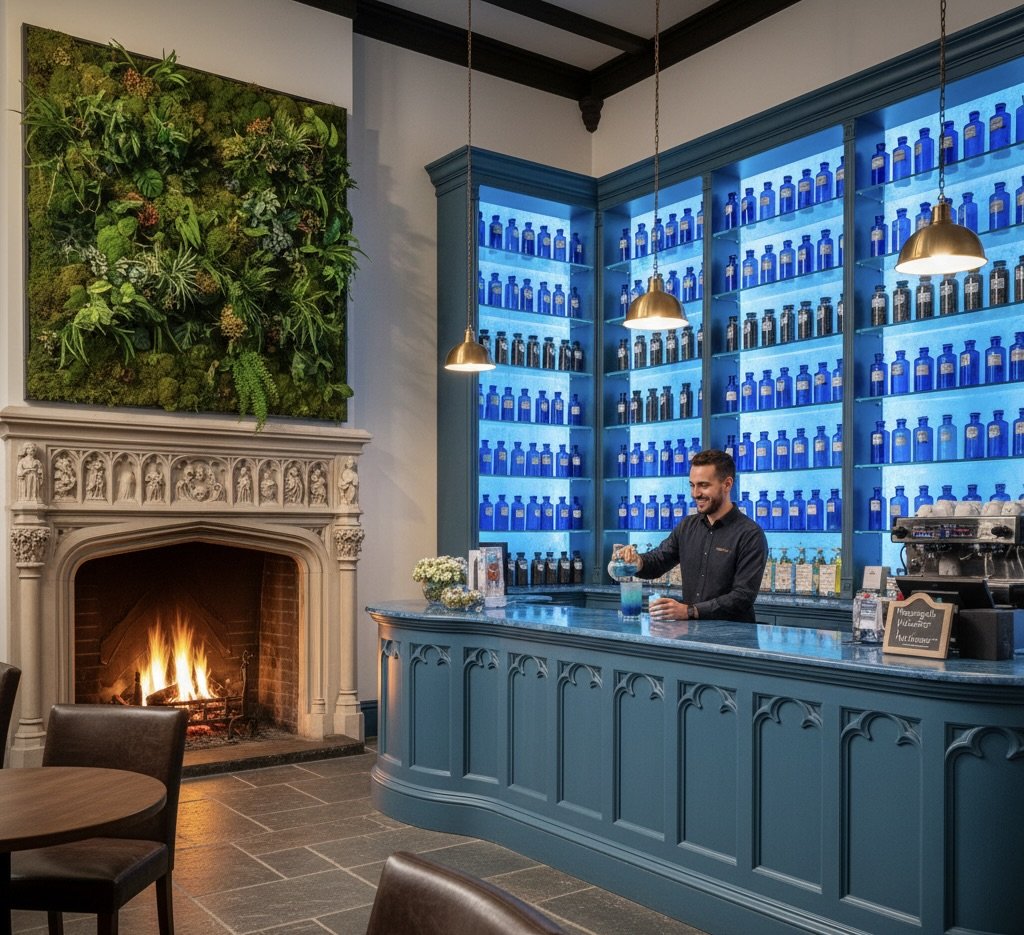
Biophilic Design: The transformation of the lower level into the Alchemical Spa and Natatorium utilizes the building’s thermal mass for temperature regulation.
Sensory Regulation: Integrating living green walls and botanical sculpture gardens within the stone chambers creates a Temple for the Body.
Individual therapy and coaching rooms must be acoustically isolated to provide "Safety as a Product" for neurodivergent visitors who require sensory-friendly environments.
Campus Element, Alchemical Function and Architectural Feature
Vaulted Ceilings: Spiritual Expansion - 60-80 ft Neo-Gothic Arches.
Stained Glass: Narrative Illumination - 16 original Bolton Brothers windows.
Stone Foundation: Physical Safety - Blue limestone and Ohio sandstone.
Grand Acoustics: Frequency Healing - Modular sound systems for ritual.
Lens IV: The Restoration Ritual, Heritage and Preservation
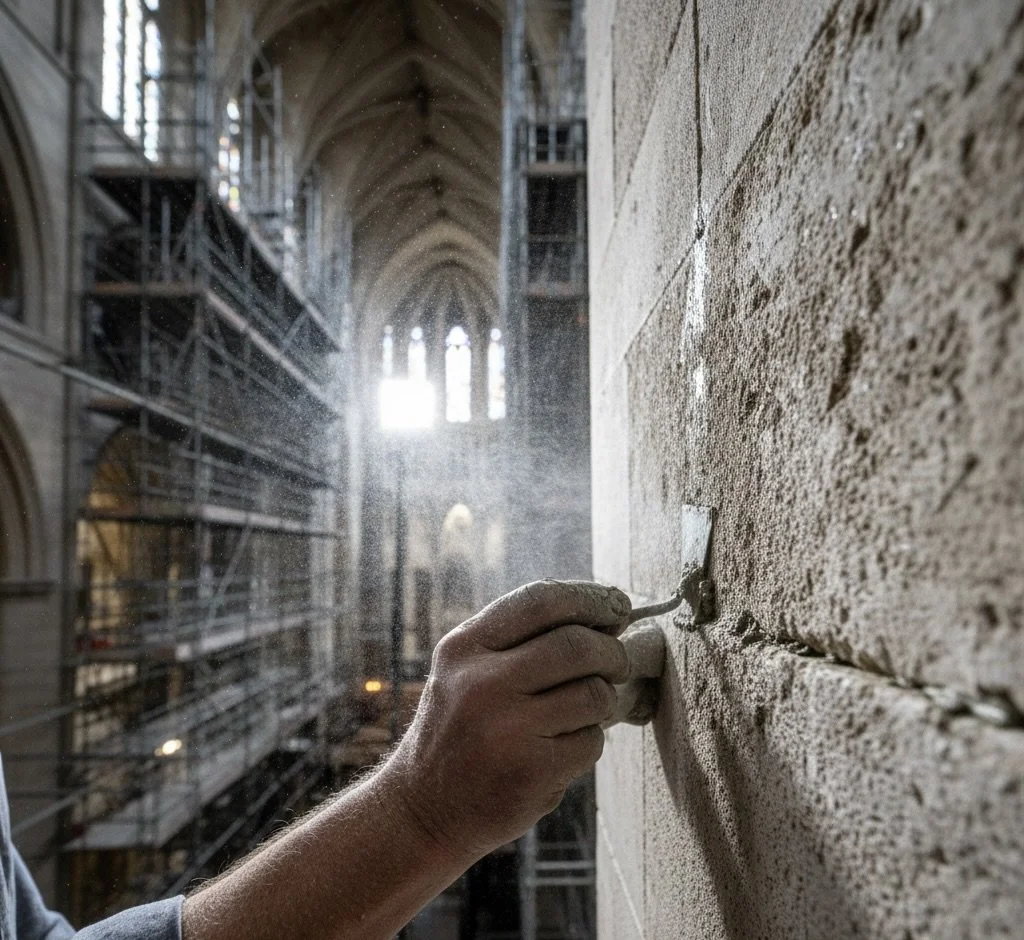
Restoring a 160-year-old landmark involves a Restoration Ritual—a slow, deliberate process of stabilizing the neighborhood's history while adapting it for a diverse future. The preservation of Saint Joseph's is the Fixed Salt that makes all other creative and financial returns possible.
Masonry and Repointing Protocols
The 1860 blue limestone facade has suffered from thirty years of dormancy and roof apertures.1 Restoration must adhere to the Secretary of the Interior’s Standards to protect the project's $7.2M in tax credit eligibility.
Repointing: We use a "soft-over-hard" protocol using Type N mortar to prevent stone spalling. Costs are assumed at $12–$25 per sq. ft..
Cleaning: Abrasive techniques like sandblasting are strictly forbidden. We employ low-pressure steam washing (200–600 psi) with non-ionic detergents to remove soot without etching the stone.
Bio-Remediation: Phase 1 priorities include the removal of pigeon guano and lead abatement, with costs averaging $2.50–$6.50 per sq. ft..
The Bolton Legacy: Stained Glass Conservation
The sixteen stained-glass windows, including figural work by the Bolton Brothers—among the first Americans to design such works—are national treasures. Conservation involves:
Studio Conservation: Panels must be removed, cleaned, and re-leaded with new cames matching the original profiles.
Protective Glazing: New hurricane-grade clear glass must be installed on the exterior with a ventilation gap to prevent moisture buildup and the yellowing of the historic glass.
Sustainable Engineering: The Geothermal Hearth
To mitigate Albany’s harsh winters and the high cost of heating a 17,500 sq. ft. cathedral, we will implement a ground-source geothermal standing column well system. This investment reduces fixed operational heating and cooling costs by 81% annually, serving as a "recession hedge" that ensures the building remains viable even when discretionary spending on festivals contracts.